HIST 2311 PCM LEARNING OBJECTIVES
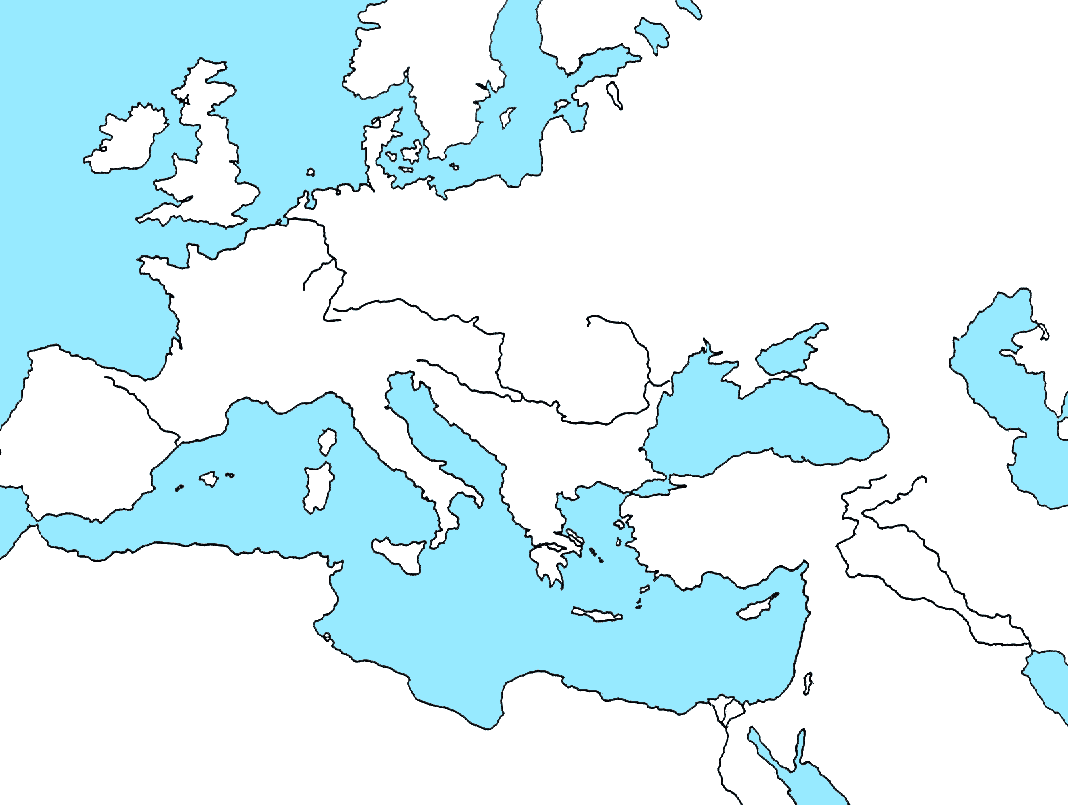
These are reproduced here for your convenience. Be aware that the list of objectives and a reproduced map for the map test are available on my Blackboard site.
Test I the map test
Because the history of Europe was shaped and influenced to a large degree by the geography of the area, it is imperative that students know the basic details of European geography. Therefore the student will be required to take a geography map test.
The multiple choice map test will be taken in the Testing Center on an answer sheet provided by the Testing Center. The map test will be the first test taken in this course and must be completed by the deadline date listed in the syllabus. PLEASE NOTE THAT GRADES ON THIS FIRST MAP TEST DO NOT ACCURATELY PREDICT FUTURE SUCCESS IN THE COURSE. GRADES ON THE MAP TEST TEND TO BE MUCH HIGHER THAN THOSE ON UNIT TESTS.
Students should consult maps in any atlas of Europe or by using Google or another search engine. You will be given a map on which areas, cities, etc. will be identified by a letter or number. In the practice question below, it is the number IV. See Blackboard for a practice map.
The test will specify thirty (30) of the following and ask students to locate them on a map:
Spain
Aquitaine
Gaul (France)
Dardanelles
England
English Channel
Holy Roman Empire
North Sea
Italy
Baltic Sea
Greece
Sicily
Russia
Gibraltar
Bohemia
Euphrates River
Crete
Madrid
Egypt
Paris
Phoenicia
London
Sinai Peninsula
Alexandria(Egypt)
Normandy
Babylon
Scotland
Rome
Sweden
Florence
Normandy
Carthage
Jerusalem
Moscow
Neapolis (Naples)
Kiev
Memphis
Athens
Thebes (Egypt
)
Sparta
Tyre,
Susa
Mecca
Byzantium
Ravenna
Damascus
Milan,
Turkey
Troy
Below is a practice map.
Test 2 over Unit I
1. Identify developments in the Paleolithic Age.
2. Describe Paleolithic art.
3. Discuss the agricultural revolution of the Neolithic and how its results.
4. Show developments that occurred in the Neolithic Age.
5. Explain why Bronze weapons were superior to stone.
6. Identify the effects of the Nile on the development of Egypt.
7. Describe the pharaoh of Egypt.
8. Discuss mummification.
9. Characterize the Middle Kingdom and explain why it ended.
10. Explain how and why the Hyksos ruled Egypt.
11. Discuss the beliefs of Akhenaton.
12 Describe Egyptian religion.
13. Describe the Mesopotamian environment.
14. Discuss Mesopotamian religion.
15. Describe Hammurabi’s Code.
16. Characterize the Phoenicians and identify their contributions.
17 Recount the history of the Hebrews to the Exodus.
18. Discuss the reigns of King David and King Solomon.
19. Discuss Hebrew religious thought.
20. Describe the Assyrian empire.
21. Describe the Persian empire.
22. Show the role of geography on Greek development.
23. Describe Minoan civilization.
24. Give examples of the love/hate relationship of later Greeks to the Minoans.
25. Describe the Mycenean culture and its collapse.
26. Identify the man who found Troy and Mycenae.
27. Identify developments in Greece's Lyric Age.
28. Describe the hoplite phalanx and its contribution to the history of warfare.
29. Describe the development of Athenian democracy.
30. Describe the development of Spartan totalitarianism.
31. Discuss the outbreak and conduct of the Persian wars.
32. Describe the subject matter of the Elgin marbles and the controversy surrounding them.
33. Discuss the outbreak and conduct of the Peloponnesian wars.
34. Describe life in Periclean Athens.
35. Describe the advantages of Philip of Macedon and show how and why he used them.
36. Describe Alexander the Great’s invasion of the Persian empire and account for his success.
37. Describe Alexander’s vision for his new empire and what happened to it.
38. Characterize Alexander the Great’s economic legacy.
39. Describe Alexandria.
From Egyptian Burial Practices
40.Explain what a mastaba is and how classic pyramids developed from then.
41.Describe how pyramids were built.
42. Explain why pharaohs moved their burials to the Valley of the Kings and what resulted.
43. Explain what a kouros is.
44. Show how the Kritios Boy develops the kouros form.
45. Be able to discuss how the Youth of Anticythera is different from earlier statues and why it is
so unusual.
46. Name the major Greek dramatists.
47. Identify Asklepios, the Greek site sacred to him, and explain his significance.
48. Explain why Greeks went to Delphi.
49. Describe the theater of Dionysius.
50. Describe Greek theatrical performances.
51.Explain what middens is, how it was used at Skara Brae, and what rooms looked like.
52.Describe tomb architecture such as that at Maes Howe.
53.Describe the life and ideas of Socrates.
54. Describe the life and ideas of Plato.
55.Describe the life and ideas of Aristotle.
56.Identify the major historian of ancient Greece.
Test 3 over Unit II
1. Show how geography influenced Rome.
2. Define fasces and imperium and be able to discuss the founding of Rome.
3. Explain the background to the Struggle of Orders and how it was resolved.
4. Describe Rome’s early conquests.
5. Identify the differences in how Rome treated the east and west.
6. Describe the causes and conduct of the Punic Wars.
7. Define corvus and show its significance.
8. Show the problems Rome experienced in the last years of the Republic.
9. Discuss Caesar’s career and the changes he made in Rome.10.
10. Describe the assassination of Julius Caesar and its consequences.
11.Discuss government under Augustus and how he ruled Rome.
12. Describe the Pax Romana.
13. Be able to describe the followers of Augustus and assess their achievements.
14. Identify problems in Rome’s reliance on slave labor.
15. Briefly describe the relations between Rome and the Jews up to the end of the Jewish War.
16.Identify the problems associated with using the Gospels as historical sources.
17. Distinguish between Peter and Paul on their views of Jesus' teachings, and show how Christianity spread.
18. Describe the problems in the Roman empire following Marcus Aurelius.
19. Identify the main developments of Diocletian’s reign.
20. Identify the main developments of Constantine’s reign.
21. Identify Justinian’s conquests and show their effects.
22. Describe Hagia Sophia.
23. Describe Byzantine culture and society.
24. Identify and discuss the differences between the Roman Catholic church in the west and the Orthodox church in the east.
25. Discuss the problem of iconoclasm.
26. Describe the Koran and the main ideas of Islam.
27. Show how the ideas of Islam helped it to spread.
28. Discuss the differences between Shia and Sunni Muslims.
29. Describe developments in the Abbassid dynasty.
30. Show how the Catholic church aided the growth of the Carolingian dynasty.
31. Describe the career of Pepin III.
32. Explain how Charlemagne came to be Holy Roman Emperor and how he conceived of his role.
33. Characterize the Carolingian Renaissance.
From Roman housing
34. Describe a Roman dwelling.
35. Describe Roman roads.
36. Describe the layout of Rome.
37. Describe the Roman baths.
From Roman Intellectuals
38.Identify the major Roman writers of the Augustan Age..
39. Identify the writers of the Silver Age and distinguish them from the Augustan or Golden Age.
From Ravenna
40. Explain why Ravenna is important.
41.Show why San Vitale is unusual.
42. Show how mosaics were made and what makes those at San Vitale so unusual.
43. Describe Galla Placida’s tomb and show why it is unusual.
From Translating Ancient Languages
44. Explain what hieroglyphics are and who first translated them.
45. Define Linear B, show where it cam from, and explain when it was decoded.
46. Explain why Etruscan is unusual.
47. Explain what minims are, why they were used, and give examples.
Test 4 over Unit III
1. Explain where feudalism came from.
2. Account for feudalism’s success.
3. Show the problems with the feudal system.
4. Discuss chivalry.
5. Describe the major physical changes between the 10th to 14th centuries.
6. Identify the major changes in agriculture and assess their significance.
7. Describe medieval health problems.
8. Describe the medieval Catholic Church’s view of marriage.
9. Describe developments in marriage and the family during the Middle Ages.
10. Show the development of the Cluny order and assess its significance.
11. Show the development of the Cistercian order and assess its significance.
12. Describe the Gregorian revolution.
13. Show what happened in the investiture controversy and assess its significance.
14. Identify the motives for the crusades.
15. Describe the new knightly orders arising from the Crusades.
16. Discuss the results of the Crusades.
17. Describe the Albigensian crusade.
18. Describe the building of the Gothic cathedrals.
19. Distinguish between Gothic and Romanesque cathedral styles.
20. Show how and why towns developed.
21. Show the importance of town development.
22. Show how the economic revival helped the growth of anti-Semitism.
23. Identify the outcomes of the economic revival.
24. Discuss how William the Conqueror took England and what he did with it.
25. Show the main developments under Henry II of England.
26. Discuss the background and appearance of the Magna Carta.
27. Discuss the background and significance of Parliament.
28. Show how Philip Augustus created France.
29. Show how St. Louis and Philip IV continued the advancement of the French monarchy.
30. Discuss the development of a unified Spain.
31. Show why Frederick Barbarossa failed to unify the Holy Roman Empire and what resulted.
32. Compare and contrast the Kievan state with the Mongol one in Russia.
33. Identify important developments under Ivan III the Great.
34. Identify important developments under Ivan IV the Terrible.
35. Explain why Bubonic Plague spread so fast in the 14th century.
36. Show the results of the bubonic plague on European society.
37. Show the causes of the Hundred Years War.
38. Describe the career of Joan of Arc.
39. Show the results of the Hundred Years War in England.
40. Show the results of the Hundred Years War in France.
From Viking Raids and Exploration
1.Explain who the Vikings were, and why and how they attacked Europe.
2. Show how the Viking ship made raiding possible.
3. Discuss Viking raids and settlements in Russia.
4. Discuss Viking penetration of Iceland and Greenland.
5 Explain why and when the Vikings abandoned Greenland.
The Romanesque style-Vézelay
1.Explain the survival of Vezelay.
2.Discuss the sculpture of Vezelay.
3.Explain who rebuilt Vezelay and discuss the accuracy of the reconstruction.
The Gothic Style-Chartres
1.Describe the construction of a Gothic Church.
2. Name the first Gothic church.
3. Explain why the façade of Chartres cathedral is unusual to moderns.
4. Explain the orientation of a cathedral.
5. Discuss gargoyles.
6. Explain the controversy surrounding how to preserve Gothic cathedrals.
From London, a Medieval City
1.Discuss the layout of medieval London.
2. Explain how London looked in the Middle Ages.
3. Explain where Westminster was and the significance of its location.
4. Explain why little remains of medieval London.
Test 5 over Unit IV
1. Characterize the Renaissance.
2. Explain why the Renaissance began in Italy.
3. Identify the ideals of the Renaissance.
4. Discuss consumerism and quantification in the Renaissance.
5. Characterize humanism.
6. Show how Renaissance art reflected Renaissance ideals.
7. Discuss the differences between the northern and southern Renaissances.
8. Show how northern Renaissance painting reflected their ideals.
9. Discuss Erasmus and his ideals.
10. Discuss marriage among Catholics and Protestants.
11. Discuss women in the Renaissance.
12. Explain when the witch craze began and how and what it involved.
13. Discuss food in the Renaissance.
14. Show how armies impacted Renaissance social life.
15. Show how printing impacted the Renaissance.
16. Identify the problems afflicting the papacy in the early Renaissance.
17. Discuss the precursors to the Protestant Reformation and discuss their ideas.
18. Identify the main complaints of reformers.
19. Discuss Luther’s ideas and his criticisms of the Catholic Church.
20. Discus the political impact of Luther’s ideas.
21. Discuss the beliefs of Calvin.
22. Show why Henry VIII created the English Reformation and what resulted.
23. Identify the new orders created in the Catholic Reformation.
24. Explain what the Council of Trent did and how it reflected political concerns.
25. Show how the Baroque reflected Catholic Reformation ideas.
26. Discuss Charles V’s ideas and how he set about accomplishing them.
27. Identify the advantages Philip II had over his father his goal.
28. Discuss the revolt in the Netherlands and who came to their aid.
29. Discuss the failure of the Armada..
30. Show the policies of Francis I.
31. Discuss France’s wars of religion.
32. Evaluate the reign of Henry IV of France.
33. Discuss the causes of the Thirty Years War.
34. Discuss the provisions of the Peace of Westphalia.
35. Show why Renaissance exploration occurred.
36. Discuss Portuguese exploration.
37. Discuss the successes and failures of Columbus’ voyages.
38. Show how the new imperialism affected Renaissance society.
39. Discuss what was imported from the New World.
40. Show why Portugal and Spain could not continue their exploration.
41. Show why England prevailed in exploration.
42. Discuss the domestic system.
43. Discuss the changes in agricultural production of the 17th century.
From Renaissance Art
1. Show how Giotto changed western art and give examples.
2. Show how Masaccio’s work developed new ideas for Renaissance art.
3. Show how Michelangelo’s work reflects renaissance concerns and his own as well.
From Florence
1. Name the structure that dominates the Florence skyline.
2. Identify what is missing inside the old walls of Florence.
From the Dutch Golden Age
1. Show how the environment of the Netherlands influenced its buildings.
2. Identify Dutch developments in “hardware” and “software” that allowed her Golden Age to begin.
3. Identify the main artists of the Dutch Golden Age.
4. Explain why the Dutch Golden Age ended.
From Six Wives of Henry VIII
1. Explain why Henry VIII wanted a divorce from Catherine and what arguments he used to get it.
2. Identify the last wife of Henry VIII and show what became of her.
HIST 2311 PCM Sample Test Questions
The following are sample test questions you might expect to encounter on the exams. They fall into two categories: 1) the "EXCEPT" type question and 2) the both "a" and "b" variety.
The "EXCEPT" type question is used when there is more than one factor that precipitated the event in the Learning Objective, or there is more than one outcome. It is important that you recognize all these factors or outcomes. Therefore the question reads:
1. ALL the following were developments of the Paleolithic Age EXCEPT:
a. Human health declined as humans moved out of Africa, because man, for the first time,
began facing diseases caused primarily by worms and protozoa.
b. They used stone implements, especially the primitive hand ax.
c. They used fire which permitted the penetration of colder northern areas.
d. Humans collected seeds and nuts to supplement their diet.
e. Humans did cave paintings in which they hoped to gain some power over the large animals of the period.
The correct answer is “a.”
The second type of question, the both "a" and "b" question, is used when there are two or three important factors. Thus, the question reads:
13. In regard to the love/hate relationship of later Greeks to the Minoans:
a. The Greeks did not understand that the Minoans predated them.
b. One example of a later Greek myth about the Minoans was the tale of the Minotaur.
c. One example of a later Greek myth about the Minoans was the tale of the labyrinth.
d. All the above are correct.
e. Only “b” and “c” are correct.
The correct answer is "d"
Most of the Learning Objectives have several important factors, influences, steps, results or developments and therefore as you review the text to find the answers, you ought to find three or four factors, etc. for each Learning Objective. Relatively few of the Learning Objectives can be answered with one word answers. If you find the three or four pertinent factors, etc. for each Learning Objective, WRITE OUT your answer, and then study your notes; you ought to do very well on the exams. If you simply skim the text looking for one word answers to the Learning Objectives, you will have difficulty with the exams. Put the time into studying and you should be pleased with the test results.