| PSYC 2301 Introduction to Psychology Summer, 202410 Week Session: May 28 - August 4 81182 DIL 001 Hybrid RRC1 1313.00 MW 8:00am- 10:00am
|
Office Hours: May 28- August 4, 2024
M W 1:30 P.M. - 2:30 P.M.
TTH 12:00 P.M. - 2:00 P.M.
By Appointment: Monday & Wednesday: 2:30 P.M. - 3:30 P.M. and Tuesday & Thursday: 2:00 P.M. - 3:00 P.M.
Office Location: Building 1000, Room # 1204.22. Phone: 223-0083.
Instructor's e-mail Address: dydek@austincc.edu
Click on the picture to visit my personal faculty web page.
Mailing Address: Austin Community College, Department of Psychology, Round Rock Campus, 4400 College Park Drive, Round Rock, TX 78665.
| |
The ACC Course Catalog offers this description of PSYC 2301:
Survey of introductory topics such as learning, memory, sensation and perception, personality, life-span development, physiological basis of behavior, stress and health, psychological disorders, social psychology, and research methods. Additional topics such as language development, states of consciousness, and psychotherapy may also be included as determined by the instructor. The Honors course provides a more in-depth introduction to the science and profession of psychology with emphasis on developing oral and written communication skills as they relate to the analysis and discussion of research and controversial issues in psychology
Course Rationale:
The rationale for a course in Introductory Psychology, also known
as General Psychology, is to introduce students to the scientific
study of behavior and the mind. Knowledge of this discipline will
provide students with knowledge of why people and animals do the things
they do and think the ways they think.
Prerequisites: None
Course Learning Outcomes:
According to the Texas Higher Education Coordinating Board’s Lower Division Academic Course Guide Manual:
Upon successful completion of this course, students will:
- Identify various research methods and their characteristics used in the scientific study of psychology.
- Describe the historical influences and early schools of thought that shaped the field of psychology.
- Describe some of the prominent perspectives and approaches used in the study of psychology.
- Use terminology unique to the study of psychology.
- Describe accepted approaches and standards in psychological assessment and evaluation.
- Identify factors in physiological and psychological processes involved in human behavior.
Program Level Student Learning Outcomes:
- Understand psychological concepts and be able to recognize them in real-world contexts.
- Acquire a basic understanding of major perspectives in the field.
- Gain an awareness of the breadth of the academic discipline of psychology.
- Understand the various research methods psychologists use and critically evaluate evidence.
General Education Student Learning Outcomes for PSYC 2301:
Critical Thinking Skills
• Gather, analyze, synthesize, evaluate and apply information
for the purposes of innovation, inquiry, and creative thinking.
Communication Skills
• Develop, interpret, and express ideas and information through
written, oral and visual communication that is adapted to purpose,
structure, audience, and medium.
Empirical and Quantitative Skills
• Apply mathematical, logical and scientific principles and
methods through the manipulation and analysis of numerical data or
observable facts resulting in informed conclusions.
Personal Responsibility
• Identify and apply ethical principles and practices to decision-making
by connecting choices, actions and consequences.
Social Responsibility (Civic and Cultural
Awareness)
• Analyze differences and commonalities among peoples, ideas,
aesthetic traditions, and cultural practices to include intercultural
competence, knowledge of civic responsibility, and the ability to
engage effectively in regional, national, and global communities.
Teamwork
• Consider different points of view to work collaboratively
and effectively in pursuit of a shared purpose or goal.
Instructional Methodology:
These Summer, 2024 PSYC 2301 classes will be taught as hybrid lecture sections. That means that one half of the instruction will be in the form of required face-to-face lectures. Live, actual, face-to-face attendance is expected. The other half of the instructional material will be presented, examined and graded in Blackboard, i.e. online. All of the major exams, Chapter Quizzes, and Discussion Boards will be administered in Blackboard. The instructional format of the class will be that of a lecture course, with required Discussion Board participation, chapter quizzes, and online exams. Student participation in the form of questions, comments and discussion is greatly desired. Students will be expected to learn the lecture material! They will also be expected to read and study the textbook for this class. Written learning objectives accompany this syllabus. These objectives inform the student as to what textbook material is likely to be covered on the exams.
In response to COVID-19-related campus closures,
Austin Community College now provides free, secure drive-up WiFi to
students and employees in the parking lots of all campus locations.
WiFi can be accessed seven days a week, 7 am to 11 pm. Additional
details are available at Drive-up
Wifi.
The Student Affairs Help Desk can assist with questions you have about ACCmail, ACCeID, Admissions and Records, Financial Aid, and general Advising questions:
Email: helpdesk@austincc.edu
For Information & live
chat visit austincc.edu/help
Students who submit the Student Technology Access Form and indicate they need help accessing their online learning environment to successfully complete their courses are eligible to check out an ACC iPad for use during the semester. You must be registered for a credit course, Adult Education, or Continuing Education course.
Grades will be determined by thirteen chapter quizzes, contributing a potential maximum total of 200 grade points. and four major hour exams, each counting 100 points toward the final grade. There will also be required homework in the form of Discussion Boards in Blackboard. The exams and chapter quizzes will be multiple-choice in nature. The exams and quizzes are open book, open notes, open internet and open collaboration exams with a specified time window for availability. Exams, discussion boards, and chapter quizzes will be made available in Blackboard for limited time with a stated deadline. The deadlines for the discussion boards, chapter quizzes and major exams will not be extended for any reason. See the course schedule for your class to view the various deadlines for the activities in this class. The exams and chapter quizzes may be taken multiple times within their time window of availability and the highest score will be recorded in the grade book.
Make-Up Exams will be provided in Blackboard for students who fail to take the First, Second, and/or Third Exam before the deadline. The Make-Up Exams are only for students who fail to take a regularly scheduled major exam. They will be deployed in Blackboard and will be open book exams, just like the initial exams. They too can be taken multiple times to raise the score. The Make-Up Exams must be taken before the date of the next regularly scheduled major exam. If not taken, a score of zero will be maintained for the missing required exam. The Make-Up Exams will have 100 questions on them instead of the 50 questions on the initial exams and will place a stronger emphasis on the studying of the textbook. The regular major exams are to be preferred, unless necessity indicates otherwise. There is no Make-Up Exam for the Fourth Exam because the semester ends with that exam.
Homework is required in the form of thirteen required Discussion Boards in Blackboard, i.e. one for every chapter in the course. A rubric will be utilized to provide a score from 1-5 points for the quality of your Discussion Board participation. The rubric can be seen in Blackboard.
• 1 point is unacceptable
quality
• 2 points for poor quality
• 3 points for acceptable quality
• 4 points for good quality
• 5 points for Excellent quality
Each required Discussion Board Homework assignment has a specific time window during which it is available for student participation. Please Note: The deadlines for the Discussion Boards will not be extended for any reason. Late work will not be accepted. Students who do not post their comments during the window of availability for any Discussion Board will forfeit the opportunity to participate in that Discussion Board for points toward the course grade. Similarly, the required Chapter Quizzes, which will be automatically scored in Blackboard, will have a specific time window of availability. The deadlines for the Exams, Chapter Quizzes, and Discussion Boards are itemized in the Class Schedule for the class.
With thirteen Discussion Boards,
the maximum score for the Discussion Boards would thus be 5 X 13=65 points.
The required Chapter Quizzes will provide a potential total of 200 points.
With the four 100 point major exams providing up to 400 points, Chapter
Quizzes providing up to 200 points, and the Discussion Boards providing
up to 65 points, the course grade will be based on the percentage of the
maximum available points, which is 665 points.
• A point total of 90% or more of the available 665 points, i.e. 599
or more, will result in a grade of A in the course.
• A point total of 532 - 598 points, i.e. 80 - 89.9% of the available
points, will result in a grade of B in the course.
• A point total of 466 - 531 points, i.e. 70 - 79.9% of the available
points, will result in a grade of C in the course.
• A point total of 399 - 465 points, i.e. 60 - 69.9% of the available
points, will result in a grade of D in the course.
• A point total equal to or less than 399 points, less than 60% of
the available points, will result in a grade of F in the course.
The major Exams in this class count 60% of the course grade.
The required Discussion Boards count 10% of the course grade. The required
Chapter Quizzes will count 30% of the course grade.
You can check your grades throughout the course by selecting the My Grades link in Blackboard.
Attendance/Class Participation
Regular and timely class attendance and participation in online discussions and completion of chapter quizzes is expected of all students. If attendance or compliance with other course policies is unsatisfactory, the instructor may withdraw students from the class. The student is responsible for communicating with their professor and completing any assignments or other activities designated by their professor.
Incomplete Grades
An incomplete (grade of "I") will only be given in Summer, 2024 due to extenuating circumstances. What constitutes “extenuating circumstances” is left to the instructor’s discretion. If a grade of I is given, the remaining course work must be completed by a date set by the student and professor. This date may not be later than two weeks prior to the end of the Fall, 2024 semester. A grade of I also requires completion and submission of the Incomplete Grade form, to be signed by the faculty member (and student if possible) and submitted to the department chair.
If an Incomplete is not resolved by the deadline, the grade automatically converts to an “F.” Approval to carry an Incomplete for longer than the following semester or session deadline is not frequently granted.
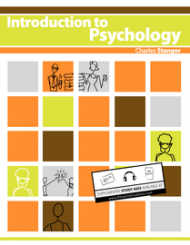
The textbook for this course is: Introduction to Psychology by Charles Stangor; FlatWorld Knowledge Publishers. (ISBN (Digital): 978-1-4533-4167-4) Click here to go to the publisher's web site. An All Access Pass to a digital version of the book is available for purchase in the ACC Bookstore and paperback versions can be ordered directly from the publisher by the student at the option of the student. The All Access Pass contains the Online Web Book (Read it through your browser), eBook (Pub and mobi files compatible with your iPad, Kindle, or other device), PDF Book (Print-it-Yourself or read offline), & Study Aids (Interactive tools help reinforce key terms and concepts.). Flat World offers students a variety of low-cost digital and print choices, starting at just $35.95. All of the formats can be purchased at students.flatworldknowledge.com, where you can also find more detailed explanations of each format. For those who prefer it, there is an OER (no cost) version of the textbook, which is: Stangor, Charles. Introduction to Psychology (PDF - 14.0MB). 2010. (Courtesy of Charles Stangor and the Saylor Foundation.)This is the first version of Stangor's book, which was published in 2010. It will suffice for this class. There is a html version of the textbook at this link.
Note: The no-cost options described here do not provide access to the practice quizzes that are provided in the commercially available e-book option cited above. It is the student's responsibility to read the assigned chapters of this book in a timely manner.
Austin Community College offers support services for students with documented physical or psychological disabilities. Students with disabilities must request reasonable accommodations through the Office for Student Accessibility Services on the campus where they expect to take the majority of their classes.
A word about Scholastic Dishonesty: This is a serious problem and is one of the most self-defeating behaviors which any student may display. Acts prohibited by the college for which discipline may be administered include scholastic dishonesty, including but not limited to cheating on an exam or quiz, plagiarizing, unauthorized collaboration with another in preparing outside work. Academic work submitted by students shall be the result of their thought, research, or self-expression. Academic work is defined as, but not limited to tests, quizzes, classroom presentations, discussion boards, and homework. Plagiarism is the submittal of someone else's work as one's own. It will not be tolerated. Nor will any form of cheating during exams. If convicted of scholastic dishonesty in this course, the student will receive an F. This topic and many others are covered in the official ACC College Catalog.
Students are expected to be mature and responsible citizens. Any student whose conduct or dress at any time is in violation of the law, is a public nuisance, or is deemed improper or detrimental to the College may be subject to disciplinary action. Students are expected to respect the rights and welfare of other members of the College community and its guests. Violence, the threat of violence, any disruption to the learning process, or intimidation will be subject to disciplinary action.
The Department of Psychology respects Academic Freedom. Each student is strongly encouraged to participate in class. In any classroom situation that includes discussion and critical thinking, there are bound to be many differing viewpoints. Students may not only disagree with each other at times, but the students and instructor may also find that they have disparate views on sensitive and volatile topics. It is my hope that these differences will enhance the class and create an atmosphere where students and instructors alike will be more encouraged to think and learn. Therefore, be assured that your grade will not be adversely affected by any beliefs or ideas expressed in class or assignments. Rather, we will respect the views of others when expressed in classroom discussions.
Although the instructor reserves the right to drop any student from this class when it is appropriate and indicated, your registration is your responsibility! If you stop engaging and participating in this class for any reason, be sure to submit an online withdrawal form provided by the Office of Admissions. This may prevent you from receiving a grade of F. The deadline for withdrawal in the 10 week session, is Monday, July 22, 2024. Students are responsible for understanding the impact withdrawing from a course may have on their financial aid, veterans benefits, international student status, and academic standing. Students are urged to consult with their instructor or an advisor before making schedule changes. Per state law, students enrolling for the first time in fall 2007 or later at any Texas college or university may not withdraw (receive a W) from more than six courses during their undergraduate college career. Some exemptions for good cause could allow a student to withdraw from a course without having it count toward this limit. Students are encouraged to carefully select courses; contact an advisor or counselor for assistance.
Here is a link to ACC COLLEGE POLICIES.
 Visit some excellent web-sites
which are relevant to this course!
Visit some excellent web-sites
which are relevant to this course!
To go to the ACC Home Page click here!